01 · Hybrid Numerical Approaches for Rupture Dynamics
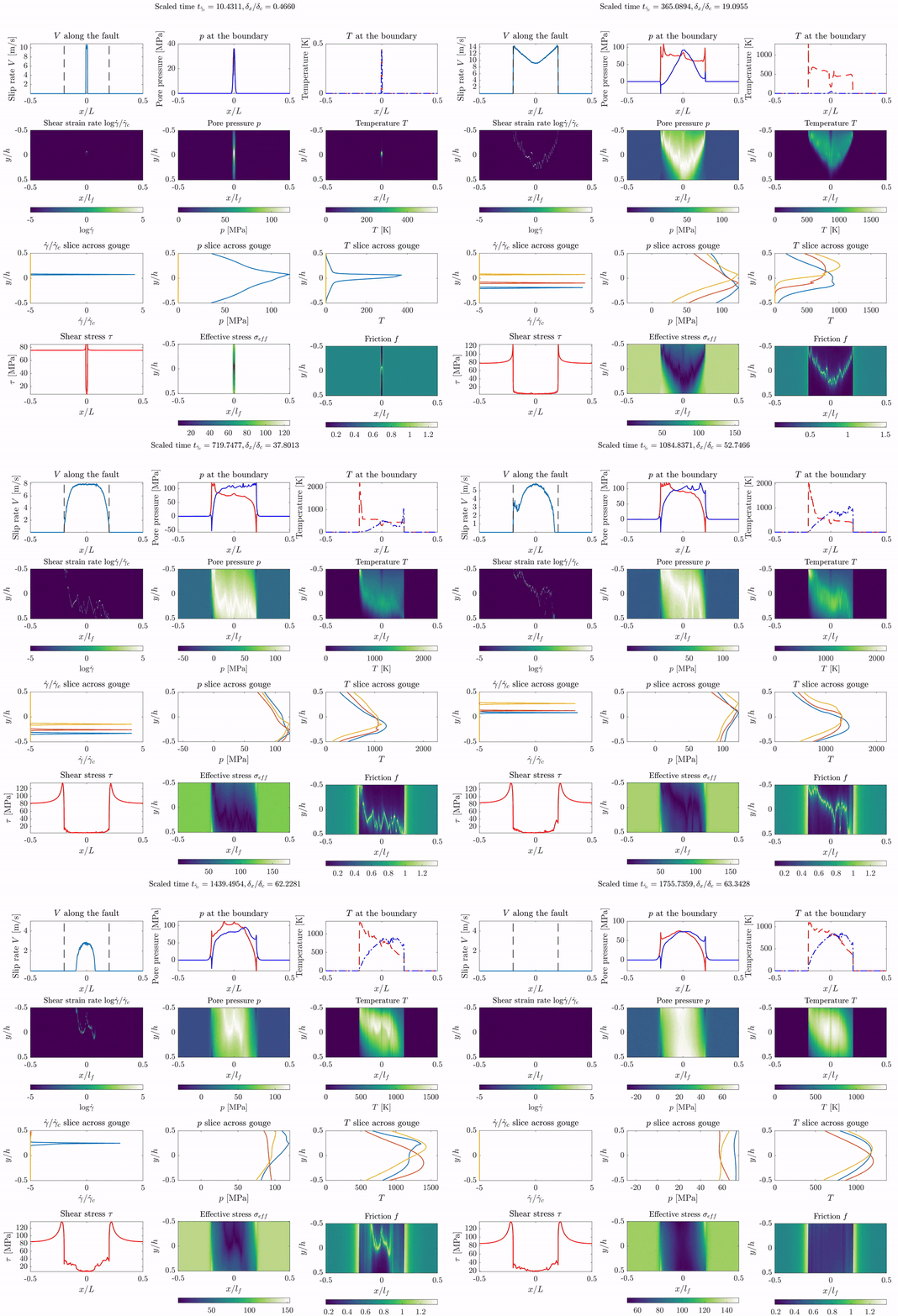
Earthquake rupture links large-scale fault slip to deformation within gouge layers only millimeters thick. I develop hybrid numerical schemes that bridge these scales by coupling a spectral boundary integral method for the surrounding poroelastic rock with staggered-grid finite differences inside the fault gouge. The framework resolves interacting heat, fluid-pressure, and deformation processes, including thermal pressurization and the emergence of narrow shear zones. Simulations show that the poroelastic response of the host rock can strongly influence how localized slip migrates across the gouge, with implications for interpreting geological records of past earthquakes. For the rapid rupture examined in this study, an undrained approximation captures much of the bulk response.
Wang, Y., and Heimisson, E. R. (2024). A coupled finite difference-spectral boundary integral method with applications to fluid diffusion in fault structures. International Journal for Numerical and Analytical Methods in Geomechanics, 48(10), 2564–2591.
Wang, Y., and Heimisson, E. R. (2026). Poroelastic bulk controls on shear localization in fault gouge during earthquake rupture: Insights from a hybrid numerical framework. Journal of Geophysical Research: Solid Earth, 131(3), e2025JB032291.
02 · Cross-scale Modelling of Injection-induced Shear Slip and Dilatancy in Granular Gouge
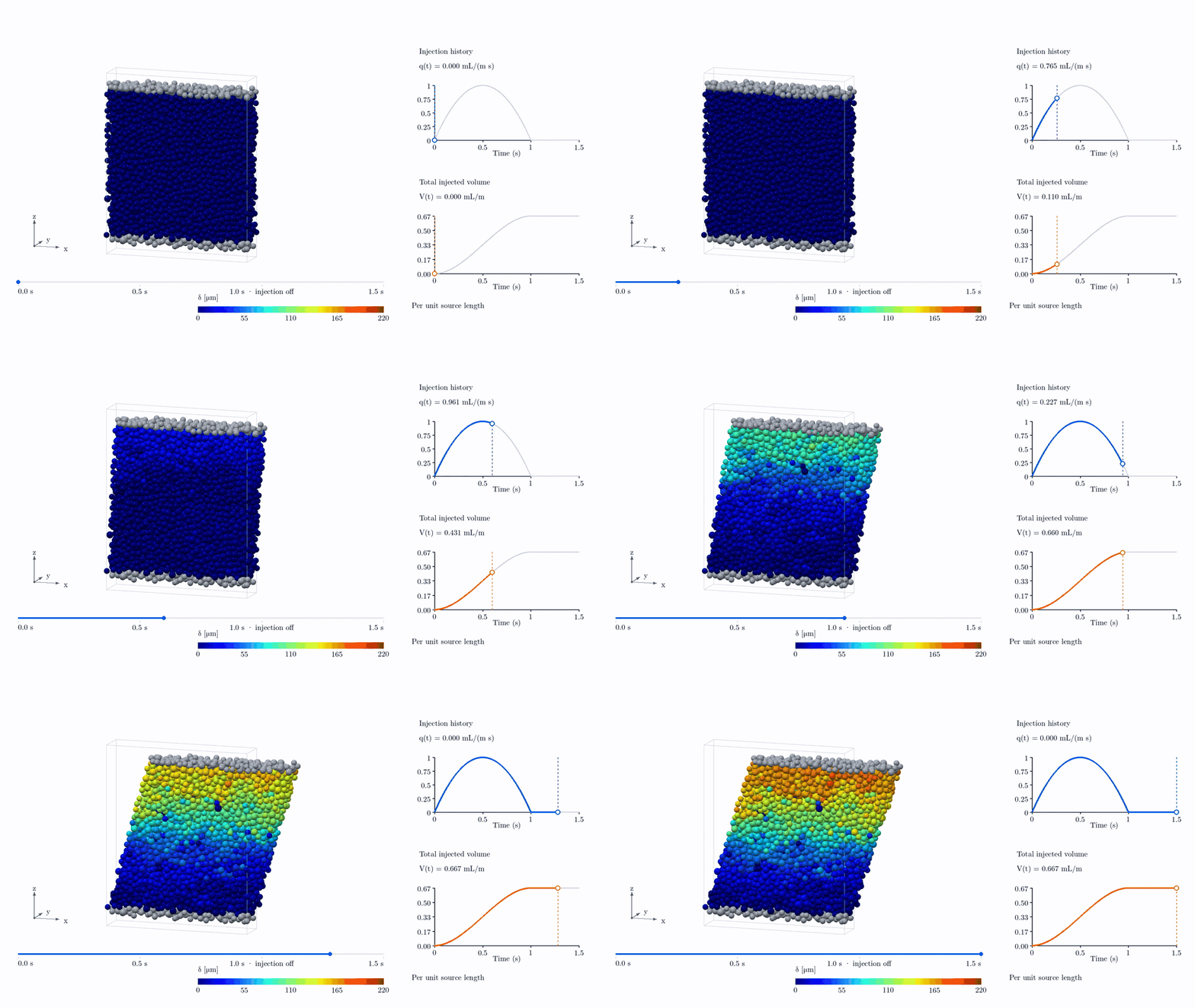
I investigate how fluid migration and pore-pressure changes influence fault slip across scales. This work connects the mechanics of individual grains and granular fault gouge with the larger-scale response of a fluid-infiltrated fault. By combining grain-scale modelling with efficient continuum and hybrid numerical approaches, I aim to understand how local rearrangements, frictional evolution, and fluid-solid interactions contribute to the onset and development of slip. The goal is to link small-scale physical processes to fault-scale behaviour and improve our understanding of fluid-induced seismicity.
03 · Damage and Cracking of Rocks
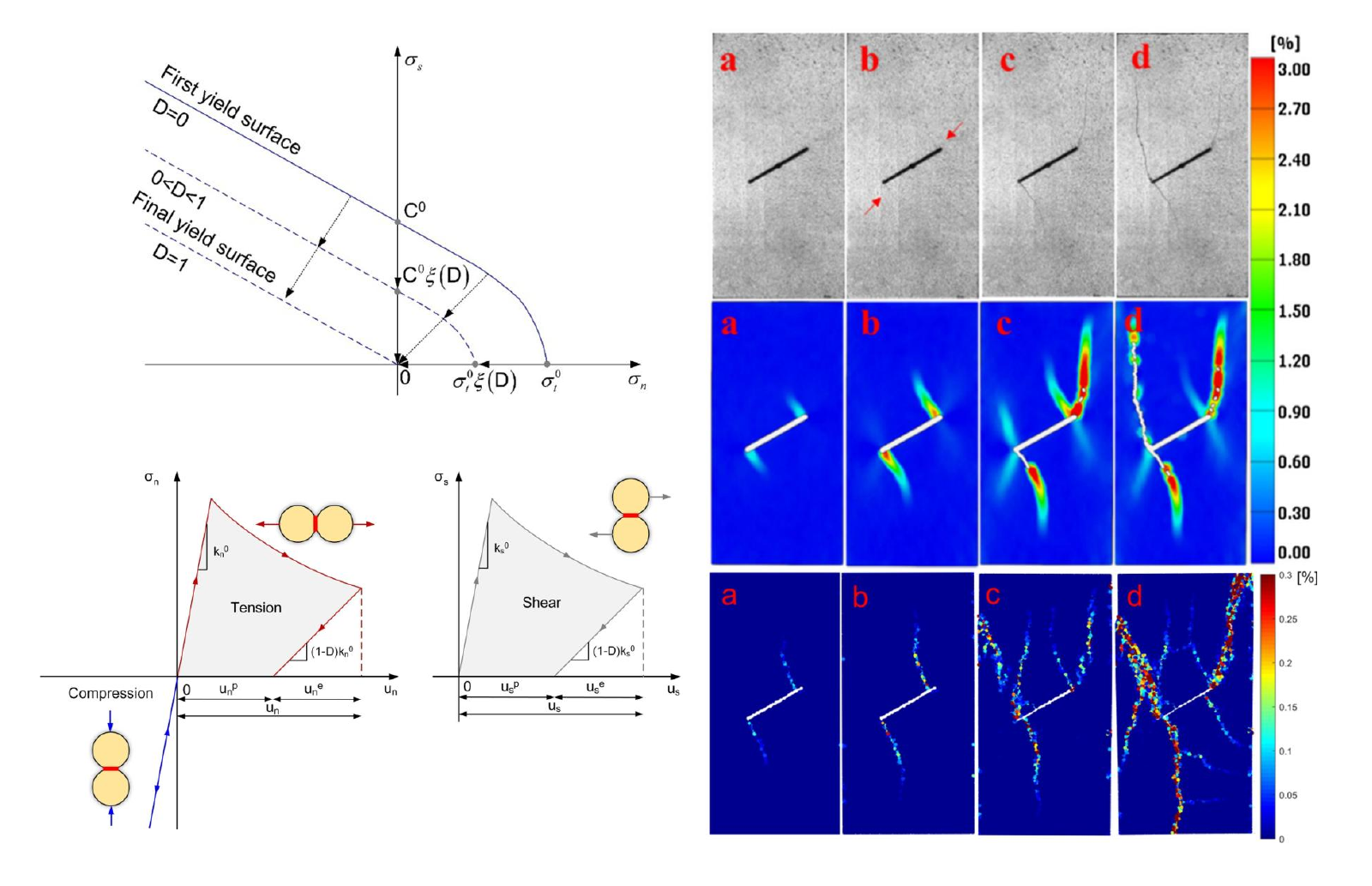
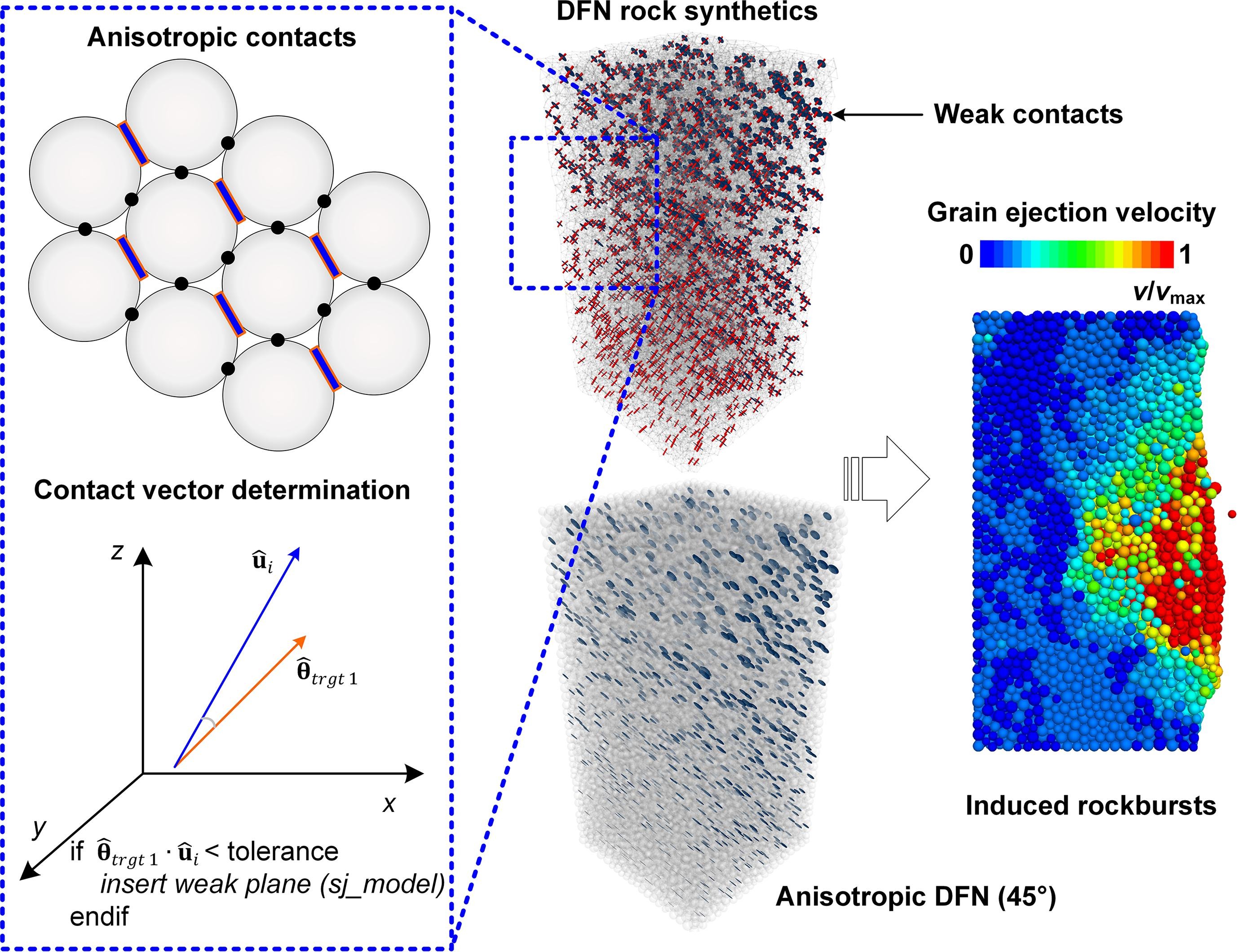
Fault gouge and host rocks can be represented as granular materials. In this representation, intergranular contact laws replace the constitutive laws used in continuum models, linking contact-scale mechanics to the macroscopic behavior of subsurface solids. Using anisotropic intergranular contacts and a self-developed elastoplastic damage contact model, I investigated rock cracking and fragmentation under triaxial stress conditions, with applications to the study of interfacial effects and rockburst analysis.
Wang, Y., and Nguyen, N. H. T. (2022). The effects of rock-infill interfacial properties on the compressive damage behaviour of flawed rocks: results from a DEM study. Theoretical and Applied Fracture Mechanics, 117, 103166.
Wang, Y., Ma, G., and Rezania, M. (2025). A granular anisotropic model of underground rockburst considering the effect of radial stresses. Tunnelling and Underground Space Technology, 155 (Part 1), 106202.
Wang, Y., Nguyen, N. H. T., and Zhao, L. (2021). Micromechanical study on hard rock strainburst using the discrete element method. Tunnelling and Underground Space Technology, 109, 103793.